
Another One Bites the Dust

Editor’s Note: I added another sketch and some comments RE calculating leg angles based off of a comment that was made on this post.
I finished the staked bench earlier this week, checking an item and a technique off my bucket list.
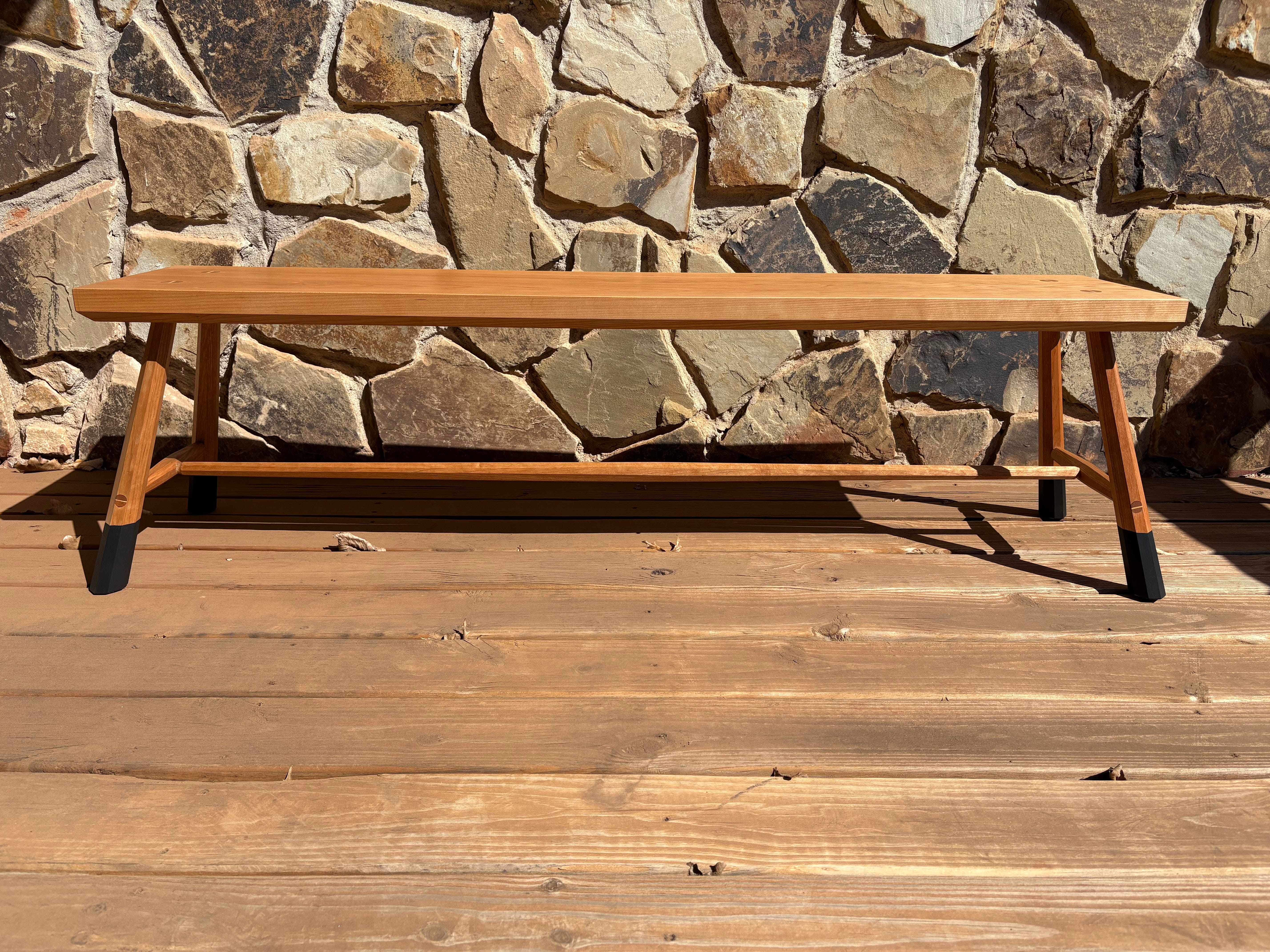


Even though it’s a simple form, it’s something I’ve had on my bucket list since I’ve seen it. This one from Shea Elliot Alexander initially caught my eye. I was debating making it for our dining table, but decided to match the table with a trestle bench instead. The other one I took inspiration from was by All in the Making, notably the absolutely chunky and heavily tapered stretchers between the legs.
‘Socks’ on staked furniture has been cropping up a lot lately, and I can’t remember the first piece I saw that utilized it. It’s such a simple thing to do but adds a lot of interest, bordering on whimsy, to my eye.
I’ve checked quite a few items off my ‘bucket list’, but they’re not all big or grand pieces of furniture. Some are small items that I think look cool, and I just want to make one myself. Here are a few:
a cabinet with sliding doors (I also used cane webbing, so it was a two-fer)
My own hand-made set of measuring tools
I keep a list in my phone of both things I’d like to make as well as techniques I’d like to try (sometimes an item is only a vehicle for a new technique). My current list looks a little like:
Something with a tambour door. They look finicky as hell, but I really want to try my hand a making one. It can be incorporated into lost of things, so it’s really wide open here.
A simple cabinet with a coopered door. Nothing too wild here, I just like the look of coopered doors and want to try it out.
Walnut Irish Arm Chair. I have a piece of walnut I’ve been saving which is big enough to be a single piece seat. I really love that chair form, and I think it’ll make a great seat for one.
Hollow Knight inspired stick chair. After abandoning the HK inspired hand shape on my last chair, I haven’t been able to get this one out of my head. I’ve got lots of ideas for it, and it’s gonna be WEIRD. I’ll be writing more about this one in the near future since I’m currently making parts for it.
A door. I can’t really explain this one, but there is something about making a door that fascinates me. I’ve watched every decent video I can find on youtube about making doors and have been reading Doormaking and Window-Making from Lost Art Press. I don’t think I’m confident enough to immediately go for an exterior door, but I might replace the one leading from the garage into the house.
Mitered Edge Dovetails. I’ve had plenty of opportunities for this one and haven’t done it yet. Normally I just go for it on a project without any worry about practice when it comes to trying out a new technique (I find I learn best when there is a little bit of pressure to execute), but for some reason, I still keep passing this one over.
The simple act of keeping a bucket list helps me look for ways to push myself to learn new things and, more importantly, keep looking at new furniture/items. If I notice my list is shrinking, that’s a good sign I need to start looking at more wooden objects. The goal, for me, is not to ‘check everything off’. The goal is to always have something on the list.
What about y’all? Anything on your bucket list.
Bonus - Bench ‘Plans’
I guess another bucket list item is ‘learn now to use some kind of software to make plans’, but I’m not there yet, so the best I can do are some sketches. In case anyone was curious about the bench dimensions, angles, etc, here is all the relevant information.
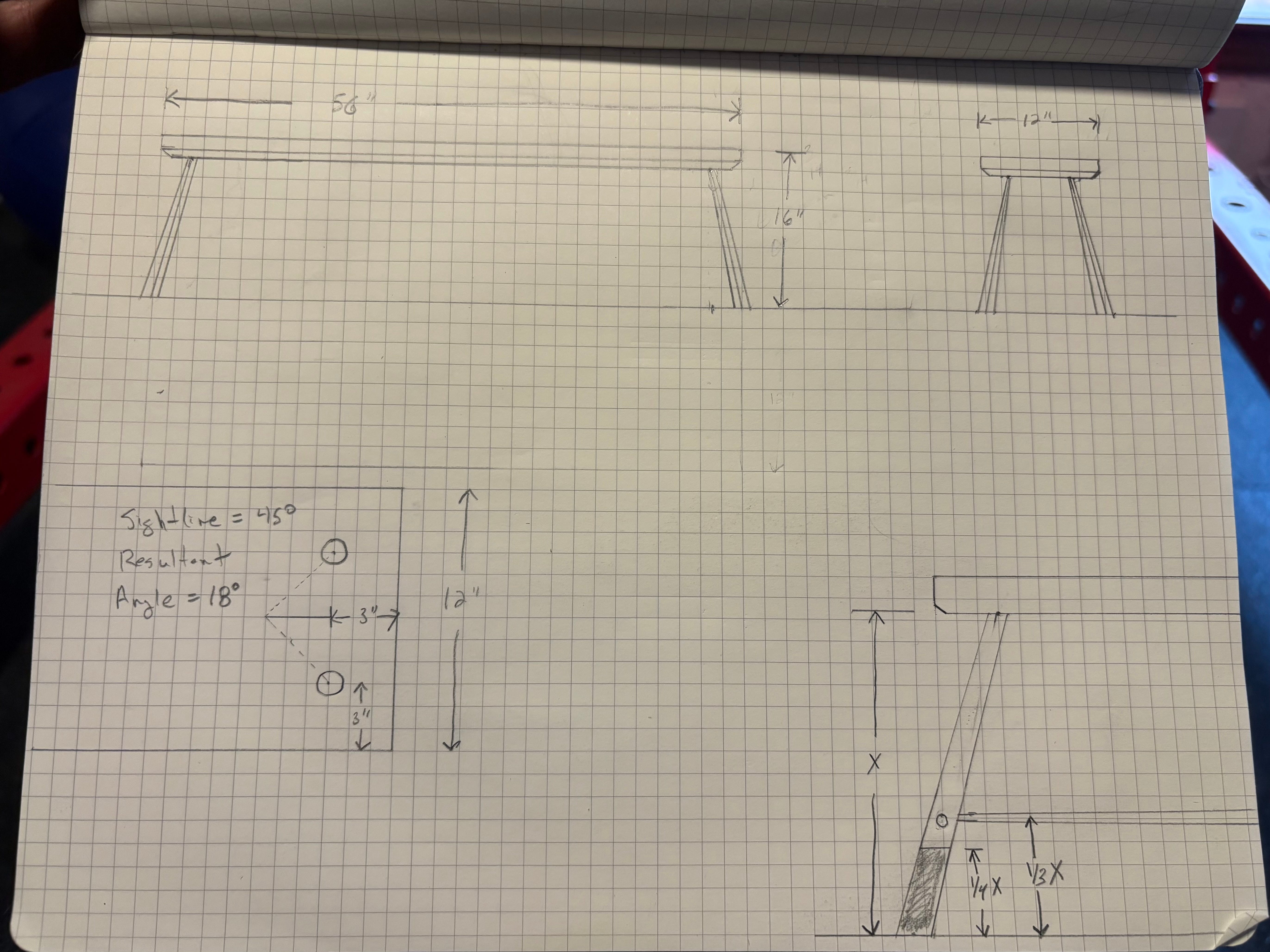
For the stretchers and socks, I didn’t bother to take measurements. I wanted to divide up the space beneath the seat proportionally for those elements, so I used my dividers to find out where to place them. The stretchers were 1/3 of the distance up the leg, and the ‘socks’ were 1/4 the distance up the leg. My original plan was to have the feet just reach the edge of the seat, when looking from the top and the side (as shown in the top 2 sketches), which yielded a resultant angle of 16.7 degrees. I bumped it up to 18 degrees to give myself some room for error (I didn’t want to short the angle, leaving the feet not fully extending to the edges of the seat).
EDIT: A question was raised RE how I came up with the angles for the legs, so I’ve added another sketch an explanation. I’m a mechanical engineer, so I’m very comfortable with trigonometry but this level of math isn’t even remotely necessary for chair/stool/bench legs. You can make scale models and adjust things until they look good and measure the angles (angles won’t change regardless of what scale you used to construct your model).
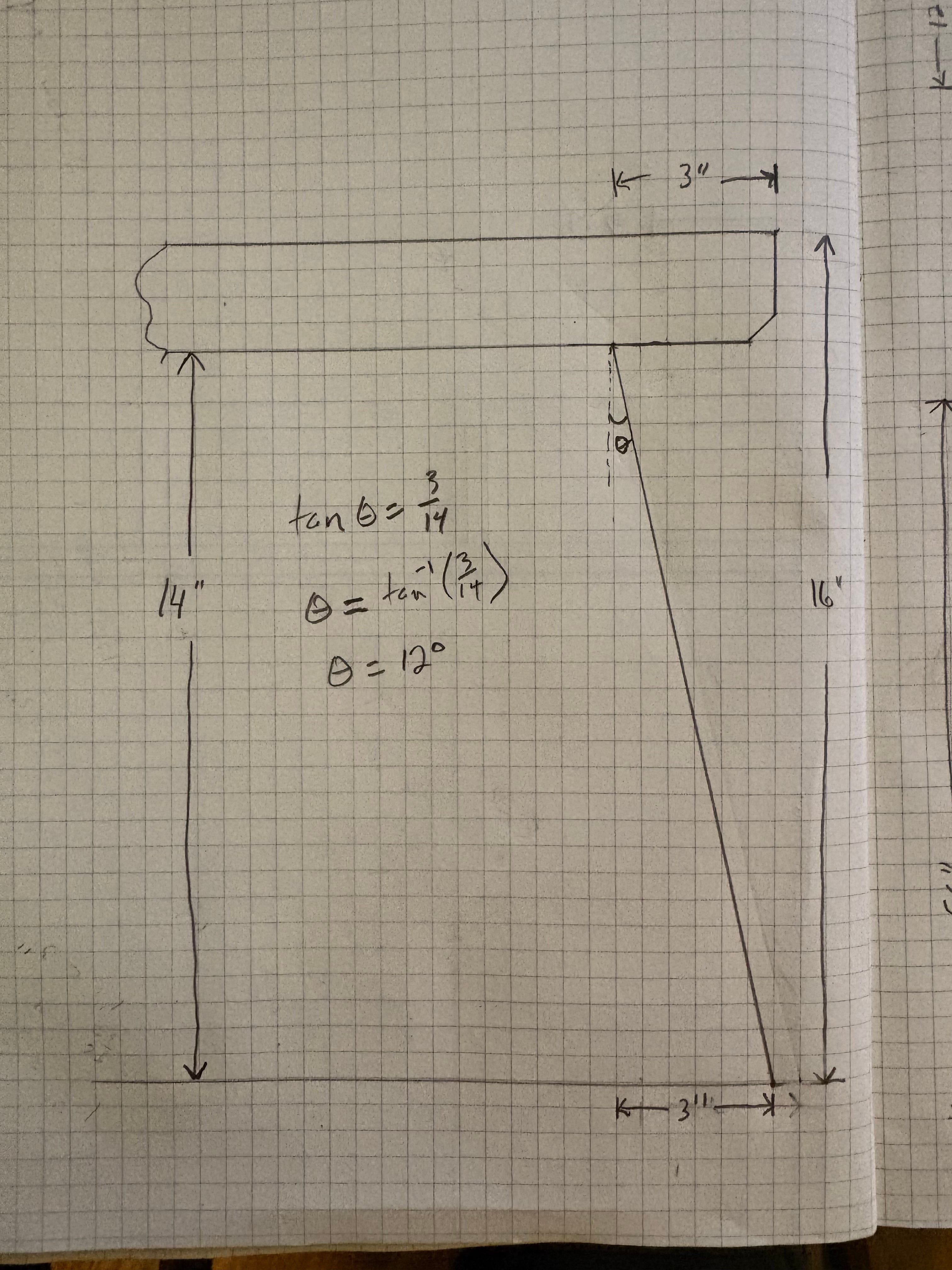
For ease of calculations and construction, I decided on a 45 deg sightline, so I only needed to sketch one side of the bench and the numbers would be the same. If the sightline was different, or the legs protect different amounts in the 2 different planes, you would need to sketch both the front and side views to calculate each angle separately, then use them to determine sightline and resultant (drilling) angle.
I want the center of the leg to just reach the ‘shadow’ of the bench seat. I believe that this helps with stability, and it should probably extend slightly past the shadow of the seat for maximum stability. You don’t want the legs extending too far past the shadow of the seat, because that increases the stress on the legs (due to the higher angle) and, more importantly, can create a tripping hazard.
For this bench, that means the leg needs to extend 3” from the mortise to reach the shadow of the seat. The length between the bottom of the seat and the floor is 14” (actually 14.25”, but when I started sketching I just assumed a 2” thick seat). This creates a triangle, with angle theta (Θ) being our drilling angle. Using the inverse tangent function (also called arctan), we can calculate this angle.
Failed to render LaTeX expression — no expression found
Arctan(Θ) = 3 / 14
For this case, that angle is 12 deg. With a sightline of 45 deg, the rake angle and splay angle are the same, so using 12 deg for both, you can plug them into an online calculator1 to determine your sightline and resultant angle. We already know the sightline (45 deg) but the resultant angle is 16.7 deg.
This is a lot of math and I tried my best to break it down, but I’m likely making a lot of tacit assumptions since it’s very intuitive for me given my background. I’ll try my best to clarify any questions in the comments.
This is not my calculator, I found it when googling rake/splay conversions.
Beautiful bench 👏👏. I have one of these on my bucket list as well. I would also like to try my hand at doors and sash windows, for no other reason than I love the joinery. Plus a table with traditional joinery, staked high stools, a wall hanging tea cabinet and a large dovetailed chest. I look forward to seeing it the rest of your bucket list when made.
Amazing piece! With all the tapering it's really quite elegant.
I'd love to know more on how you calculated the angles for the legs.