
Splitting (C)hairs

After the recent snowstorm I was itching to get back to the bench and finish up the second high stool I’ve been working on. This one was intended to be an attempt at round legs and rounded stretchers. All of my chairs and stools, so far, have had octagonal undercarriages. I don’t have a lathe, or even know how to turn, so they all started out as typical octagons and I shaped them by hand with a spokeshave. Got all my parts ready last Friday but another temp dip left me waiting until Sunday to glue it up.
Everything was set, glue was warm, parts were ready, and I had all the necessary accoutrement for glue up and assembly. After slightly fighting the undercarriage into place (a process that feels like wrestling an alligator at times), I flipped everything over to drive my wedges. The guiding rule for wedging parts has always been “when the wedge stops moving, stop hitting it”. As I drove the first wedge, I heard (and felt) a crack, but the wedge was still moving and I couldn’t see anything yet. Two more hammer blows generated massive split. I decided to drive another wedge just to see what would happen, and the entire side of the stool nearly came off.
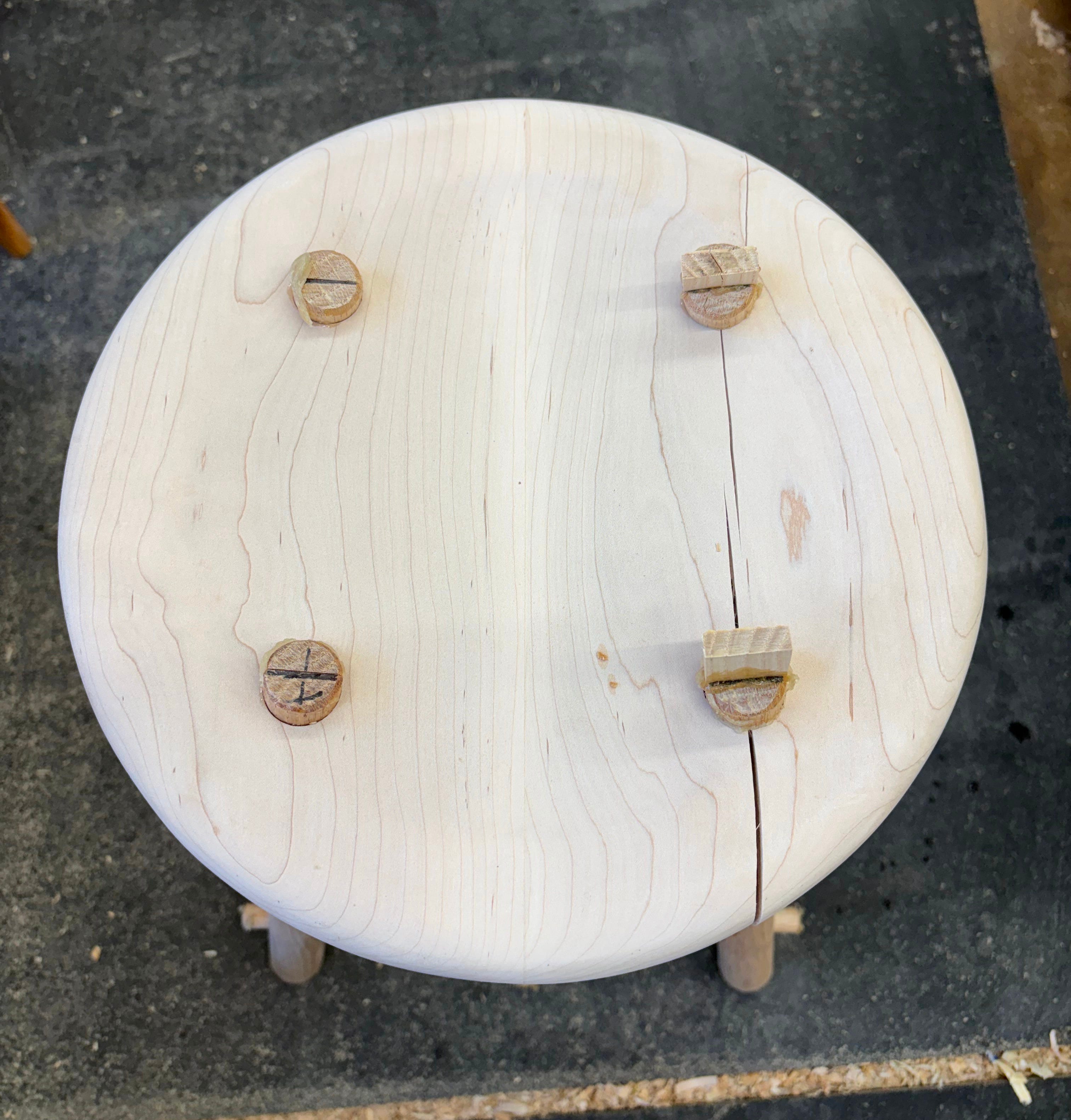
It was bound to happen eventually. I was surprisingly calm about it and the cracked seat was met with immediate acceptance. No swearing, no panicked moves to try and get glue and clamps in place, just a deep knowing that this wasn’t gonna work. I’ve had an arm crack during assembly, but it was salvageable. This was not. I disassembled everything, cleaned glue off the parts, and called it a day.
So what went wrong?
It had been very dry for the last week and I can only assume that there was almost no moisture in this stool seat, meaning it had no ‘give’ whatsoever and a crack formed and easily propagated. I’ve used soft maple multiple times for chair and stool seats, and I’ve been able to drive the legs like nails and have never had a crack form12.
The other possibility was “the wood hates me and wants me to die”.
But in all honesty, it’s a natural material so there is a large amount of variance, sometimes even within the same tree. Maple is supposed to have interlocked grain to help resist splitting, but the fracture surface on this seat looked like it had been rived cleanly.
Oh well.
Using stock I had on hand, I made another seat, but not before ‘testing’ the material. I know wood is weird and this doesn’t really prove anything, but I wanted to try it anyway. Using a spare leg from my ‘chair parts bucket’ (y’all have one of these in your shops too, right?), I drilled a hole and wedged it, hitting it well past when it stopped moving just to see if I could split it. Nope.
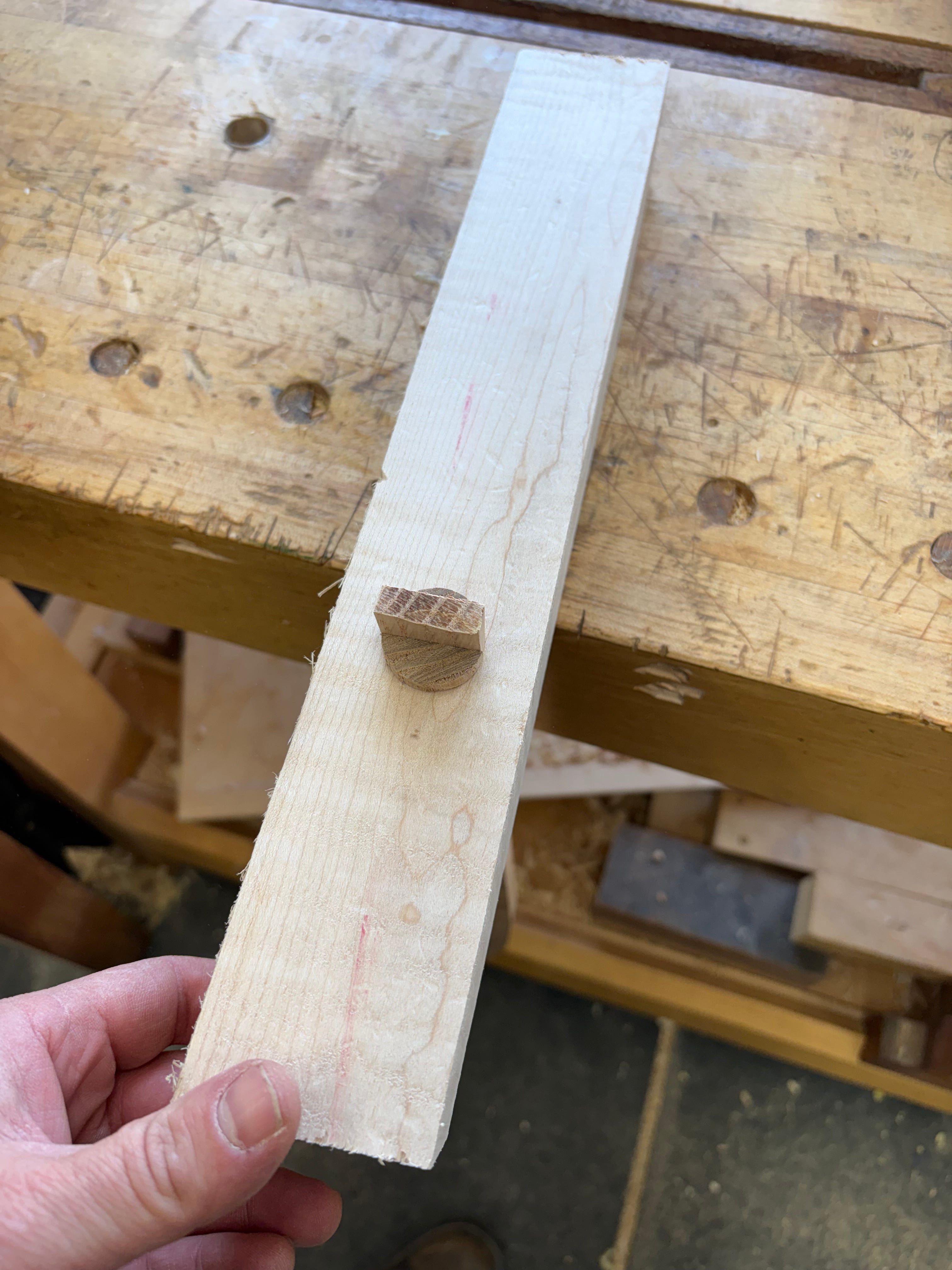
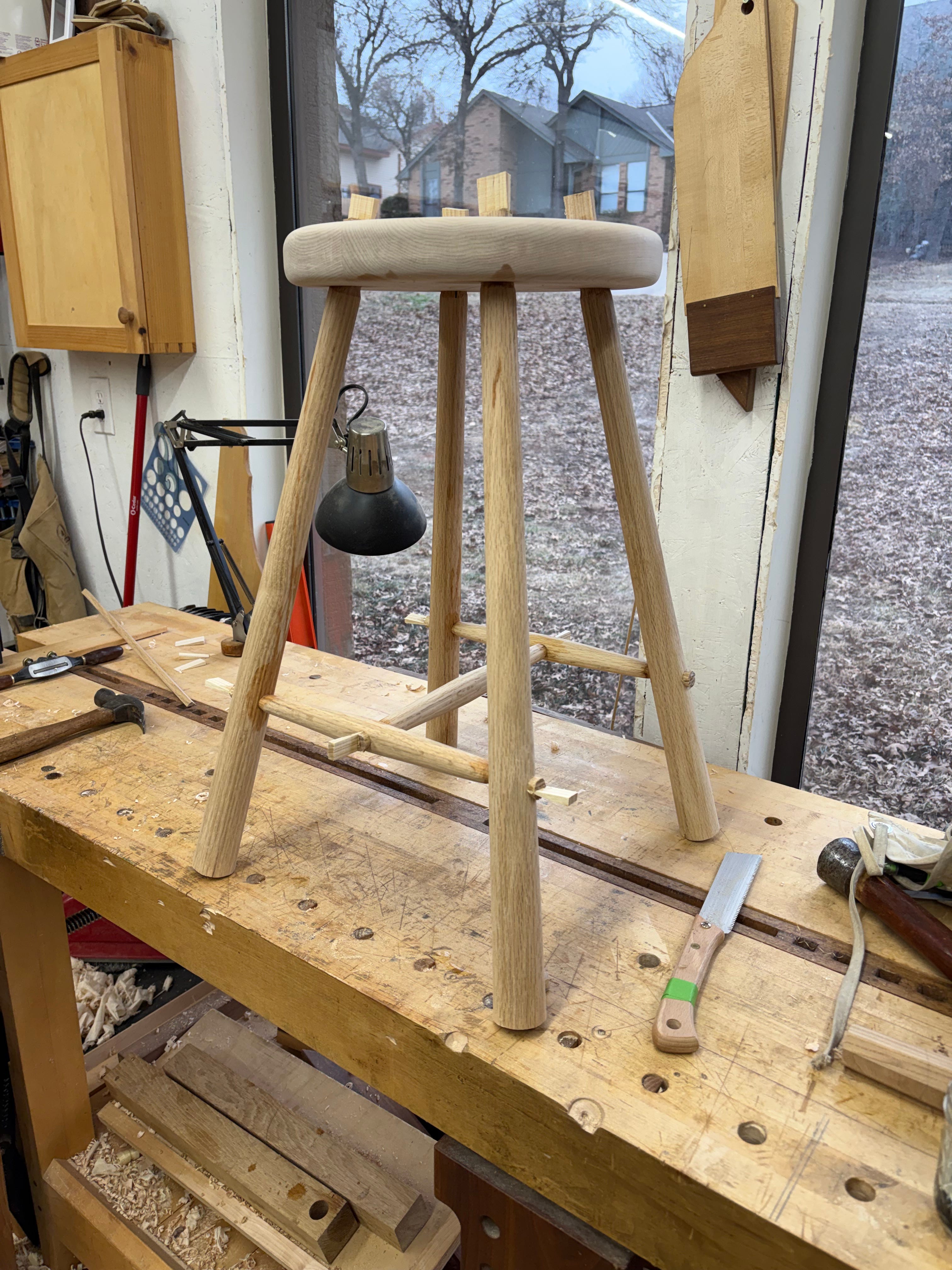
This time I drilled and fit my undercarriage BEFORE I cut it out and shaped it3. Round 2 of the glue up went as expected. I didn’t baby anything, hit the wedges until they stopped, and it all came together fine. Now I can move on to more interesting things, like trying to decide what color to paint it4.
As I was making the second seat I realized what I had on hand was likely NOT soft maple. It wasn’t quite as heavy as hard maple I’ve used before, but it was heavier and more ‘solid’ feeling than soft maple. Soft maple also has a smell to it when its being worked (specifically when sawn and sanded). It’s not exactly unpleasant, but also not good, and this new seat had none of that tell-tale aroma. It planed a little easier than hard maple (though not much) but the surface it left behind was DEFINITELY that of a harder maple. All of the drawers in my house are hard maple, so I’ve planed plenty of it to know the look/feel of hand planed hard maple. In theory, hard maple could work as a seat since it should also have interlocked grain, but I’ve never used it, so I have no experience to compare it to, versus soft maple, which is an excellent seat material.
Two footnotes for one sentence, wow! This is about the distinctions between hard and soft maple here within the US. Hard maple typically refers to one species of maple: Acer Saccharum aka rock maple or sugar maple (though black maple and florida maple can sometimes be lumped in as well). Soft maple is a broader term that basically means “maples not Acer Saccharum”, and includes: Bigleaf maple (Acer macrophyllum), Box elder (Acer negundo), Red maple (Acer rubrum), Silver maple (Acer saccharinum), and Striped maple (Acer pensylvanicum). It’s totally possible I have mostly worked with only one of these species of ‘soft maple’ and the last time I bought lumber is was of a different species that has behavior/characteristics closer to that of hard maple. Or they got the stacks mixed up.
If I had whacked myself in the face with another stool leg only a day after splitting a seat, I might’ve tilted off the face of the earth. For Gen Z that means I would’ve had an epic crash out.
Woof.
Well handled. Not much more you can do than be like “whelp, guess it’s time for me to walk away from this for a bit.”
Does this mean, I need to study latin to figure out what kind of wood I am using? I have enough trouble speaking English.